

Taking shelter in poetry and prose
When the world feels too heavy...


Like many of my friends, I find myself less than excited about daily workouts at the gym. One thing that helps lessen the misery is listening to stuff on my phone. My taste in audiobooks is fairly wide—Donna Tartt, C.J. Box, Jodi Piccoult, Elizabeth Strout. A bit of Diane Chamberlain and Jamie Ford thrown in for good measure.
And podcasts. Podcasts are self-contained, exercise-friendly little beasts. Often, I listen to podcasts for writers. The other day, I divulged from my usual habits and tuned in to On Being with Krista Tippett. The episode, entitled "This world is full of everything good, everything beautiful" was an interview with two former poet laureates—Joy Harjo and Tracy K. Smith. In an instant, I dropped into a deeper feeling state than I’d anticipated. I remembered why I’d befriended poetry during times of loss, times of loneliness and despair.
Tracy K. Smith says it better than I ever could:
“Throughout my reading life, poems have greeted me with what feels like urgent compassion. When I’m lost or afraid, the speakers of poems assure me that my feelings are nothing to hide from or deny. Indeed, that vulnerability, uncertainty, and even desperation are not only signs of life, but tools for moving forward toward courage, hope, and purpose. When I’m confident in my convictions, poems alert me to complexities I failed or been unwilling to regard. And like the best of friends, somehow the poems I’ve loved for years managed to keep evolving, meeting me where I am and then — how do they do it? — eading me still further along toward what will startle, console, and even change me. I shouldn’t be surprised, our very selves from day to day are the result of where we’ve been, what we’ve seen, how we’ve hurt and healed, and what we are on the threshold, even now, of discovering. We never cease in our becoming. Neither does this art form, this confidante, this tool designed to remind us how it feels and why it matters to love, to remember, to ache, to fear, to be astonished by what our minds can make and what our spirits can withstand.”
Here’s a poem of Joy Harjo’s that I love
Remember
Remember the sky that you were born under,
know each of the star’s stories.
Remember the moon, know who she is.
Remember the sun’s birth at dawn, that is the
strongest point of time. Remember sundown
and the giving away to night.
Remember your birth, how your mother struggled
to give you form and breath. You are evidence of
her life, and her mother’s, and hers.
Remember your father. He is your life, also.
Remember the earth whose skin you are:
red earth, black earth, yellow earth, white earth
brown earth, we are earth.
Remember the plants, trees, animal life who all have their
tribes, their families, their histories, too. Talk to them,
listen to them. They are alive poems.
Remember the wind. Remember her voice. She knows the
origin of this universe.
Remember you are all people and all people
are you.
Remember you are this universe and this
universe is you.
Remember all is in motion, is growing, is you.
Remember language comes from this.
Remember the dance language is, that life is.
Remember.“Remember.” Copyright © 1983 by Joy Harjo from She Had Some Horses by Joy Harjo. Used by permission of W. W. Norton & Company, Inc.

And a dose of magical realism
I’ve been reading Guesthouse for Ganesha, by Judith Teitelman. It’s historical magical realism.
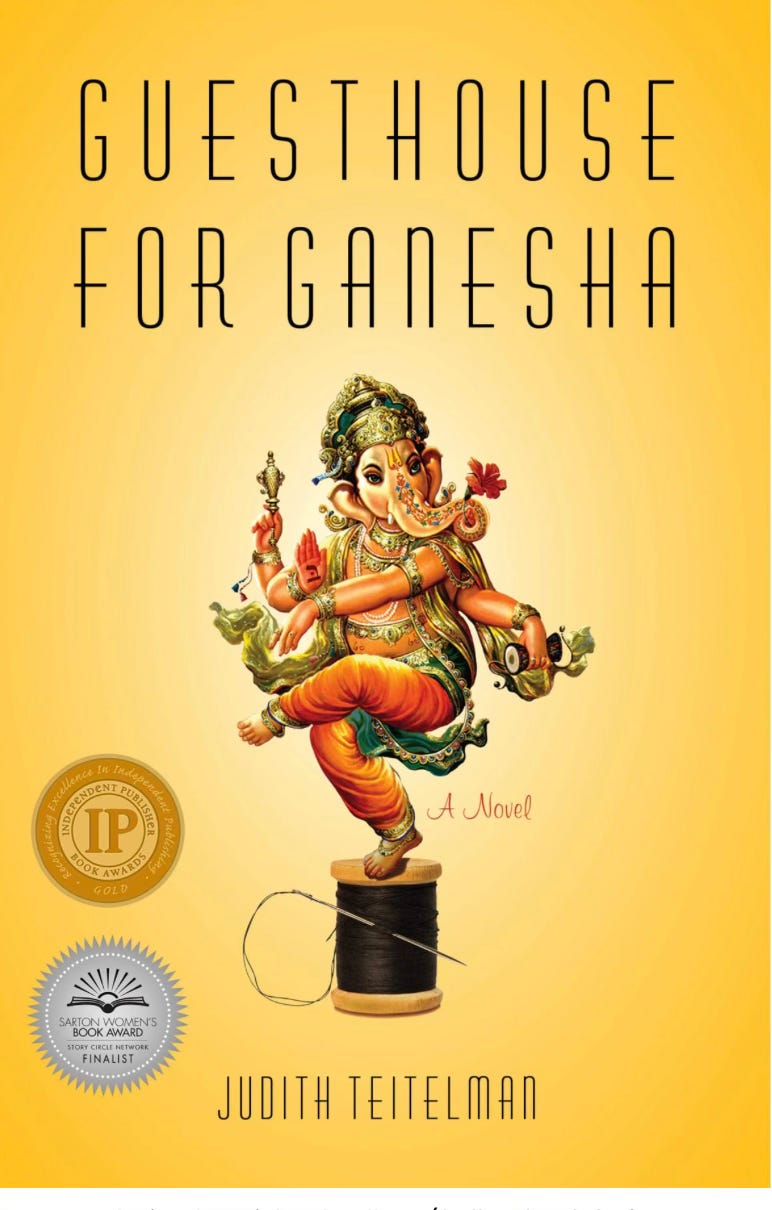
Here’s a description, in author’s words:
In 1923, seventeen-year-old Esther Grünspan arrives in Köln “with a hardened heart as her sole luggage.” Thus begins a twenty-two-year journey, woven against the backdrops of the European Holocaust and the Hindu Kali Yuga (the “Age of Darkness” when human civilization degenerates spiritually), in search of a place of sanctuary. Throughout her travails, using cunning and shrewdness, Esther relies on her masterful tailoring skills to help mask her Jewish heritage, navigate war-torn Europe, and emigrate to India.
Esther’s traveling companion and the novel’s narrator is Ganesha, the elephant-headed Hindu God worshipped by millions for his abilities to destroy obstacles, bestow wishes, and avenge evils. Impressed by Esther’s fortitude and relentless determination, born of her deep―though unconscious―understanding of the meaning and purpose of love, Ganesha, with compassion, insight, and poetry, chooses to highlight her story because he recognizes it is all of our stories―for truth resides at the essence of its telling.
Weaving Eastern beliefs and perspectives with Western realities and pragmatism, Guesthouse for Ganesha is a tale of love, loss, and spirit reclaimed.
The book is taking me away from the ordinary, into a world where the material world and the spirit world mesh. I’m enjoying it a lot. Check out Suzysbooks for this and other great books by and about women!
In the spirit of brevity, I will stop here. These times are difficult. I hope for better.
Does poetry bring you a sense of peace? A sense of belonging to something larger? Is it a source of truth? Tell me about the poets and the poetry that moves you. And if you can, listen to the On Being episode I referenced (This world is full of everything good). I’d love to know how it strikes you.
If you would like more information on me and my writing, please visit Julie’s website. You can read the first two scenes of my novel, Chapel Bay Secrets, there and order the book from the vendor of your choice

.
Julie,
I'm definitely going to listen to that podcast...I loved the quote from Tracy K. Smith. A Substack you might like to check out: https://jamescrews.substack.com/
He is a poet, and I have found his words and reflections to be very comforting, especially right now.
I love Diane Chamberlain! So good! Thanks for the book rec and I have yours on my TBR list, also!