Salt of Tears and Desert Soil
Remembering past injustices; seeking a better path


photo by the author
I first published this a year ago, on February 19, 2025. Many of my subscribers are new since then, so I’ve decided to update and republish it. Over the past twelve months, the treatment of immigrants of all kinds has worsened. I wish this topic weren’t as timely as it seems to be, but here we are.
On February 19, 1942, Roosevelt signed Executive Order 9066, giving the U.S. Army the authority to remove civilians from certain military zones in the states of California, Oregon and Washington. The result was incarceration of nearly 120,000 Americans of Japanese ancestry in one of ten concentration camps in desolate, remote regions. Many of the camps were in the high deserts, places too hot in the summer and too cold in the winter.
Japanese Americans underwent several years of immense suffering from displacement, property loss, family separation, harsh conditions, and humiliation, yet none were ever charged with espionage or sabotage against the U.S. The incarceration was, as stated in a 1982 congressional study, due to “racial prejudice, war hysteria, and a failure of political leadership.” Now, a Day of Remembrance is held each year on February 19.
The National Park Service preserves many of the former concentration camps. Tom Leatherman, Superintendent of Pearl Harbor National Memorial, was awarded a 2022 regional Cultural Resource Award for establishing the Japanese American Confinement Sites (JACS) Working Group (A Legacy to Uphold). Sadly, the recent cuts to the park service will make visiting the sites more difficult, at least in the short run (National Park Seasonal Hiring Overshadowed by Reckless Staff Cuts).
I’ve visited the Tule Lake Internment Center, located in the high desert in Modoc County, California. Close to the Oregon border, it’s lonely, windy land abutting the Tule Lake National Wildlife Refuge in the Klamath Basin. I don’t have a photo of a restored hut at the Tule Lake center, but here is a photo of one at Manzanar Internment Camp in Southern California. Manzanar is also a windy, dusty place with hot summers and cold winters. Not a location where one wants to spend years on end in hastily built, un-insulated quarters.
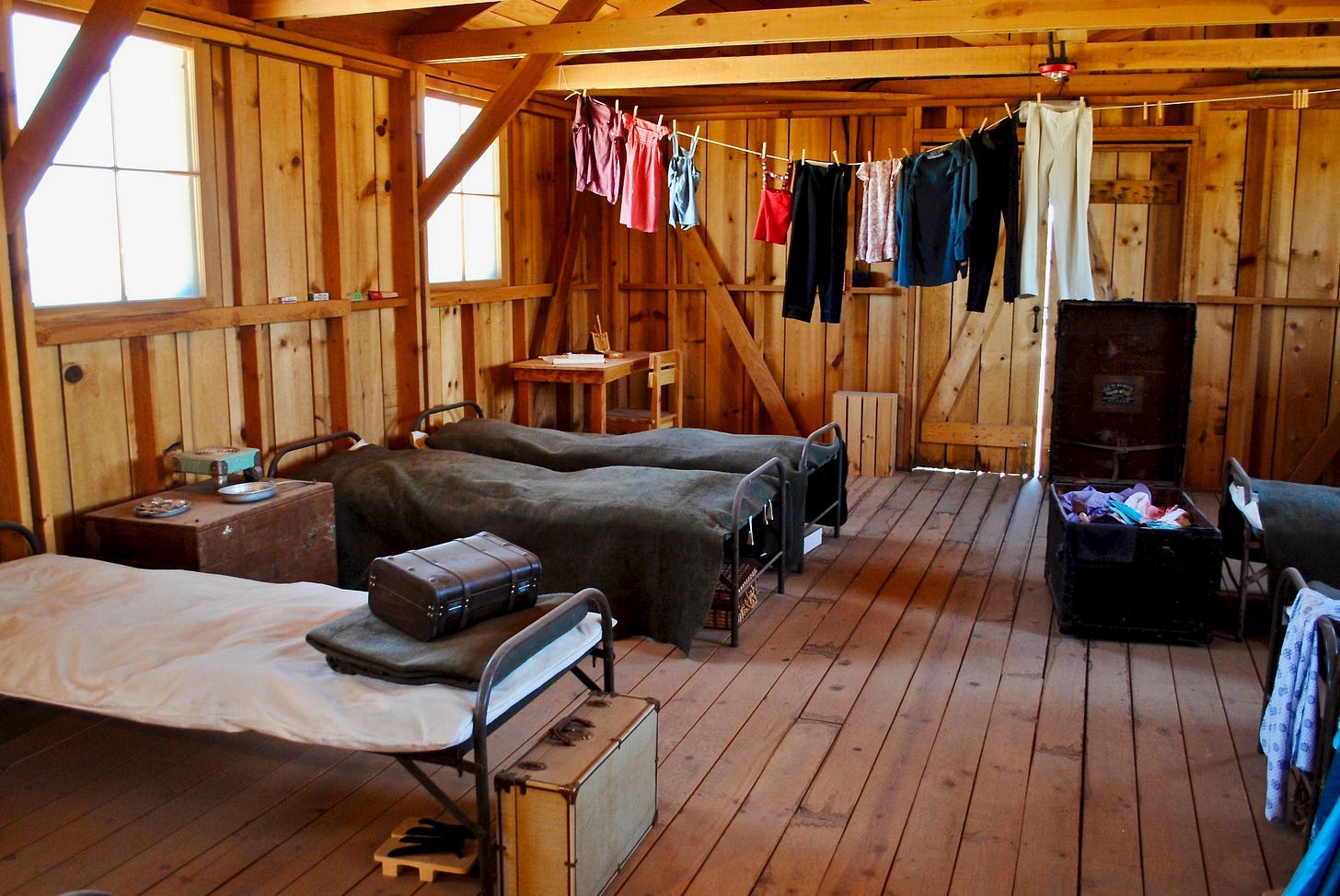
photo courtesy of DepositPhotos
There are excellent resources online for those who want to know more about the three-year stint of incarceration experienced by these citizens of the United States, people whose only sin was physically resembling those whom the country was battling overseas.
For a basic history lesson, along with live and online events happening during the week of February 16-23, check the Japanese American Citizen League’s Day of Remembrance site.
Densho, a nonprofit organization whose mission is “To preserve and share history of the WWII incarceration of Japanese Americans to promote equity and justice today,” has been around for decades. The organization collects oral and written history about incarcerated Japanese Americans and their families and advocates to ensure that this history is never repeated.
Ruth Chizuko Murai has written a thoroughly researched, very personal account of her Sacramento-area family’s displacement from their farm and eventual re-establishment of family life in the article My Family Lost our Farm during Japanese Incarceration.
Kiyo Sato, a remarkable woman who lived through the horror of internment as a young woman, wrote an award-winning account of the experiences she and her family endured as a result of this American tragedy. I had the opportunity to meet her at a recent event, and wrote about her in a post from October, 2025 (Respect, Endurance, and the Terrible Price of Fear).
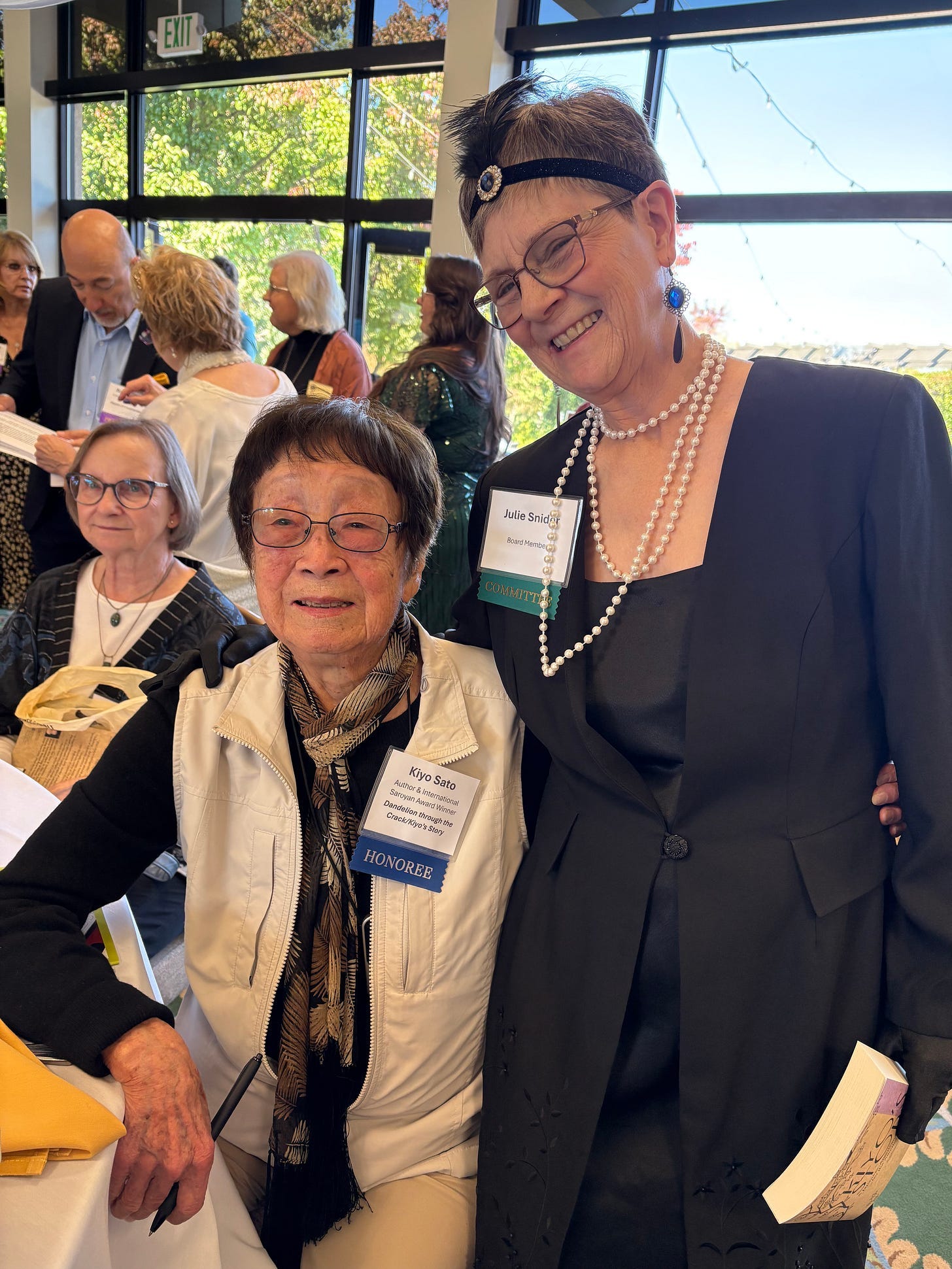
The author with Kiyo Sato, photo taken during the California Writers Club, Sacramento branch Centennial Celebration, October, 2025.
Solidarity Stories
Japanese American solidarity with the deportation of Latinos was highlighted in a New York Times article posted in December, 2025 (Haunted by History).
“Now, as the Trump administration carries out its immigration crackdown, Japanese Americans see chilling similarities to what their families experienced.
The federal government’s current efforts have focused on arresting and deporting Latinos who don’t have legal status in the United States. That contrasts with the situation in the 1940s, when most of the Japanese Americans held in detention camps were U.S. citizens.
But to many Japanese Americans, the images of uniformed federal agents ushering people onto buses, the mass detentions and the dehumanizing language used by government officials stir collective memories of the trauma faced by their own parents and grandparents.”
The article focuses on the efforts of two Japanese American women, Nicole Suzuki and Amy Oba.
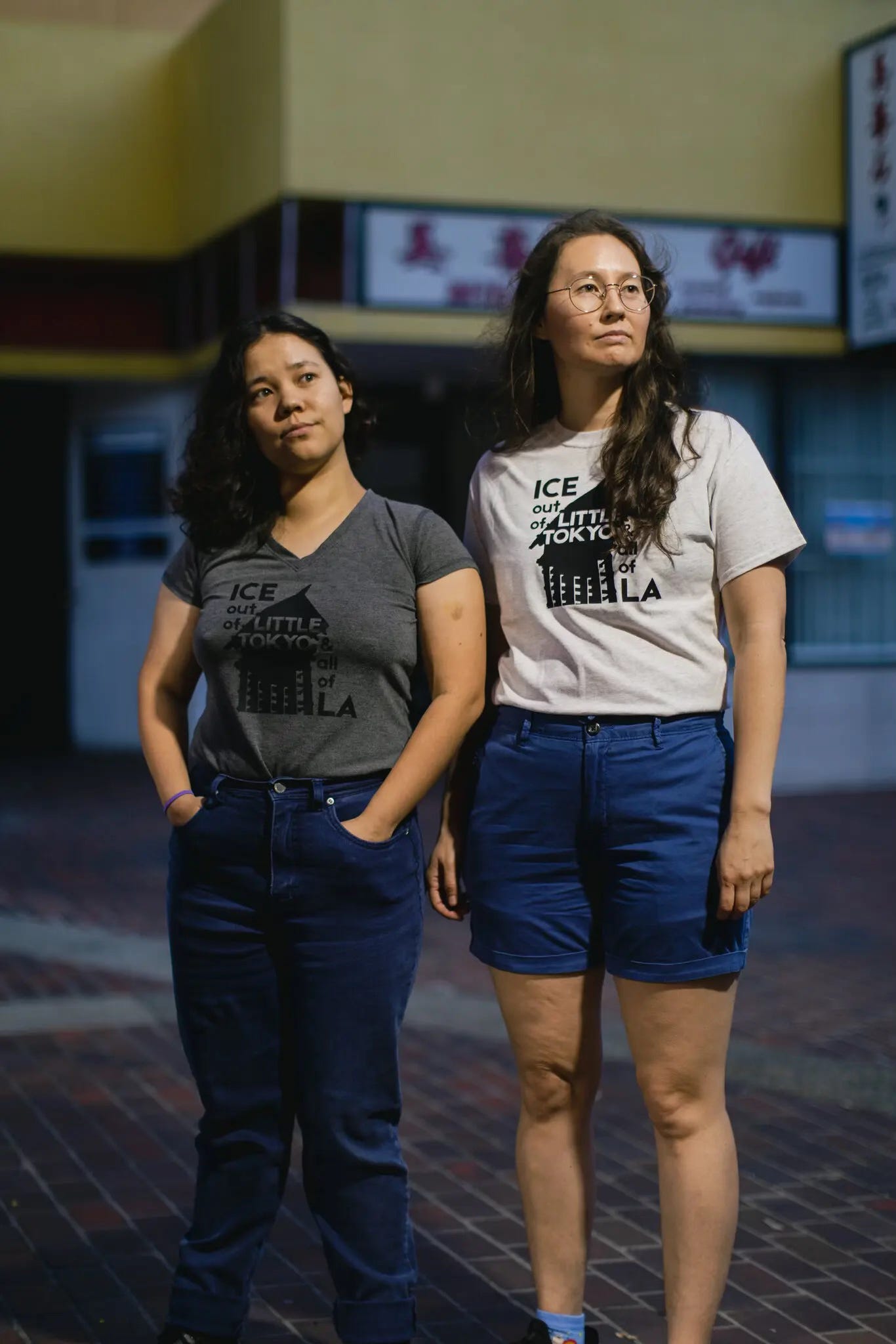
Ms. Oba, right, and her partner, Ms. Suzuki, are part of Nikkei Progressives, a group founded by Japanese American activists in 2016 to push for immigrant rights. Credit...Alex Welsh for The New York Times
According to the article in the Times,
“Ms. Oba and her partner, Nicole Suzuki, are part of Nikkei Progressives, a group founded by Japanese American activists in 2016 to push for immigrant rights. The group has raised money for undocumented immigrants affected by Los Angeles’s devastating wildfires and has served as advocates for migrants held at the Immigration and Customs Enforcement detention center in Adelanto, a desert community about 80 miles outside Los Angeles.
And as the Trump administration stepped up immigration raids across Southern California this year, the group started patrolling.
Ms. Suzuki, 28, said it was important to make sure that agents know that residents are watching what they do. On their weekly drives, Ms. Oba and Ms. Suzuki look out for unmarked vans, trucks with dark tinted windows or agents gathering behind the federal detention center.
‘I think a lot of people lose hope that they have the power, that they can do anything about what’s happening,’ Ms. Suzuki said. “But no — they could drive around their neighborhood every now and then and keep an eye out.”
Why Do I Care?
I’ve tried to understand why the Japanese Internment cuts so deeply with me, but a better question is: Why shouldn’t it?My upbringing and schooling in the Midwest during the 1960s and ‘70s failed to include this sad chapter in American history. When I learned of it some twenty years ago, I was angry. How could something of this magnitude, that affected so many Americans, not be taught in my high school American history class?
I was angry at the fact that we had concentration camps on American soil, angry that I didn’t know of them, angry that Japanese American kids I grew up with had parents who’d lived in such deplorable conditions. I didn’t have a word for it at the time, but this was one of the many ways that history was “whitewashed,” sanitized for my protection. Who was really being protected? Not the school kids.
My visit to Tule Lake made such an impression upon me that once I wrote a novel, I knew I needed to include a character touched by life in the camp. This character became Brenda Kato, daughter of a Tule Lake internee, a woman whose mother wouldn’t talk about the camps with her or even reveal the identity of her father.
If you’d like to keep up with my writing, consider signing up for Julie’s Writing Newsletter. I publish it once a month, and have giveaways and bonus content there. You’ll find more information, including how to order my novel, Chapel Bay Secrets, at Julie Snider, author